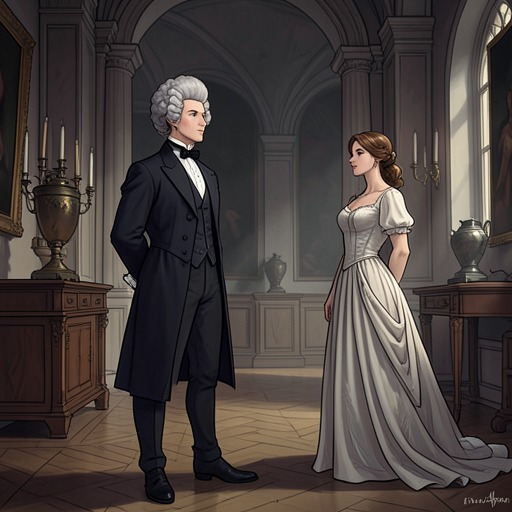
David Dirry-Moir challenges the peers and recognizes his brother after the parliamentary session
The Man Who LaughsAfter Gwynplaine’s speech in the House of Lords is derided, Lord David Dirry-Moir defends him at the hall door, challenges the peers who laughed, and then reveals that he and Gwynplaine are brothers. The episode turns public mockery into a defense of dignity, then makes that unexpected solidarity give way to a personal confrontation: David’s recognition of kinship does not reconcile the men but, in his view, makes them equals entitled to fight.
Setting and Immediate Context
The confrontation follows the parliamentary sitting in which Gwynplaine has addressed the lords. His speech was imperfectly delivered, and David acknowledges that it was confused and at times in poor taste; he nevertheless insists that some of its claims were true. He singles out Gwynplaine’s reference to the lepers at Burton Lazars as an undeniable fact. In David’s view, flaws of style do not cancel the force of testimony from someone who had been a fairground clown until the previous day.
The scene shifts to the entrance hall, where ten or twelve young lords want to leave and David stands in their way. Some still wear their parliamentary robes; others have changed into ordinary clothes. David is conspicuous in a plumed green hat tipped with orange and an embroidered, laced outfit bearing admiral’s anchors. As he addresses the group, he fingers the hilt of the sword at his waist. His appearance marks him as an officer of the fleet, while his position at the door makes his challenge literal: the peers cannot simply pass without answering him.
David’s Defense and Challenge
David condemns the young lords for turning together against one man. He grants that Gwynplaine’s speech was disordered and that its delivery did not resemble that of a practiced orator, but argues that the peers have failed to understand the truths in it. He also rejects their laughter as an adequate response to the speaker’s social position or manner. Gwynplaine’s elevation from fairground performer to peer is, to David, a striking reversal: he welcomes the restoration of the heir’s inheritance and contrasts the newcomer’s intellect with the peers’ conduct.
David says that the peers’ ridicule has offended him personally. Although he claims no right to speak in the sitting, he asserts his right to act as a gentleman and tells the assembled lords that he intends to fight them. He calls on them to arrange seconds and umpires, and makes the challenge deliberately broad: they may choose the time, place, and manner, provided the encounter gives them room to fight. His defiance extends from swords and pistols to a fistfight. The peers answer with smiles and accept; individual voices name pistols, swords, and fists as their preferred weapons. The scene thus turns the lords’ collective laughter into a series of proposed personal combats, although no duel takes place within this episode.
Gwynplaine Steps Forward
Gwynplaine emerges from the shadow and approaches the man he had known as Tom-Jim-Jack, now recognized as Lord David. He thanks David but says that the dispute is his own business. The gesture briefly brings the two men together in defense of Gwynplaine’s dignity, yet David draws back rather than accepting his gratitude as the end of the matter.
David brings up Gwynplaine’s reference to a woman who had loved Lord Linnæus Clancharlie and later Charles II. Gwynplaine confirms that the statement is true. David replies that Gwynplaine has insulted his mother. Gwynplaine immediately understands the implication and begins to infer a family connection; David completes the recognition by identifying them as brothers. The exchange reveals that the woman mentioned in the parliamentary speech was their shared mother, and that Gwynplaine’s remark has touched a grievance David treats as personal.
Recognition Becomes Conflict
For David, brotherhood establishes the equality required for combat. He strikes Gwynplaine and says that he will send his seconds, proposing that they fight the following day. The blow makes the change unmistakable: David had just defended Gwynplaine against a crowd of peers, but now directs his anger at Gwynplaine himself. He does not present their newly disclosed kinship as a reason to withdraw the challenge. Instead, he treats a brother as the one opponent who can meet him as an equal.
The event ends with that challenge unresolved. David’s defense of Gwynplaine and his assault on him remain in sharp tension: he rejects the lords’ group mockery, yet answers a perceived insult to his mother with a private demand for violence. Gwynplaine’s effort to claim the dispute as his own cannot settle the matter, because the revelation of their relationship changes its terms. What began as a confrontation between a defender and the peers becomes a threatened duel between brothers.